
iTourVoiceTranslator Frequently Asked Questions
13 questions. Select a question to view the answer.
Why can't iTour Voice Translator recognize translations when I wear headphones on a Mac computer?
This is caused by macOS restrictions on microphone and system audio access. In macOS 13 and earlier, some apps downloaded from the App Store may be unable to capture system audio, including audio played through headphones.
You can try the following:
Option 1: Install the version from the official website (recommended)
- Uninstall the version downloaded from the App Store.
- Download and install the latest version from the official website. This version may provide better compatibility with system permissions.
Option 2: Upgrade macOS
If you use a version earlier than macOS 13, try upgrading to macOS 14 or later, which may resolve the audio access issue.
Option 3: Use the computer speakers temporarily
If you cannot reinstall the app or upgrade macOS right away, unplug your headphones and use the computer speakers, then test translation again.
iTour Voice Translator on MAC systems above 13, why can't translation be enabled even though screen recording permission has been granted?
In macOS 13 and later, if iTour Translator has been granted screen recording permissions but still cannot start translation, it is because System permissions require restarting the application after authorization to take full effect.
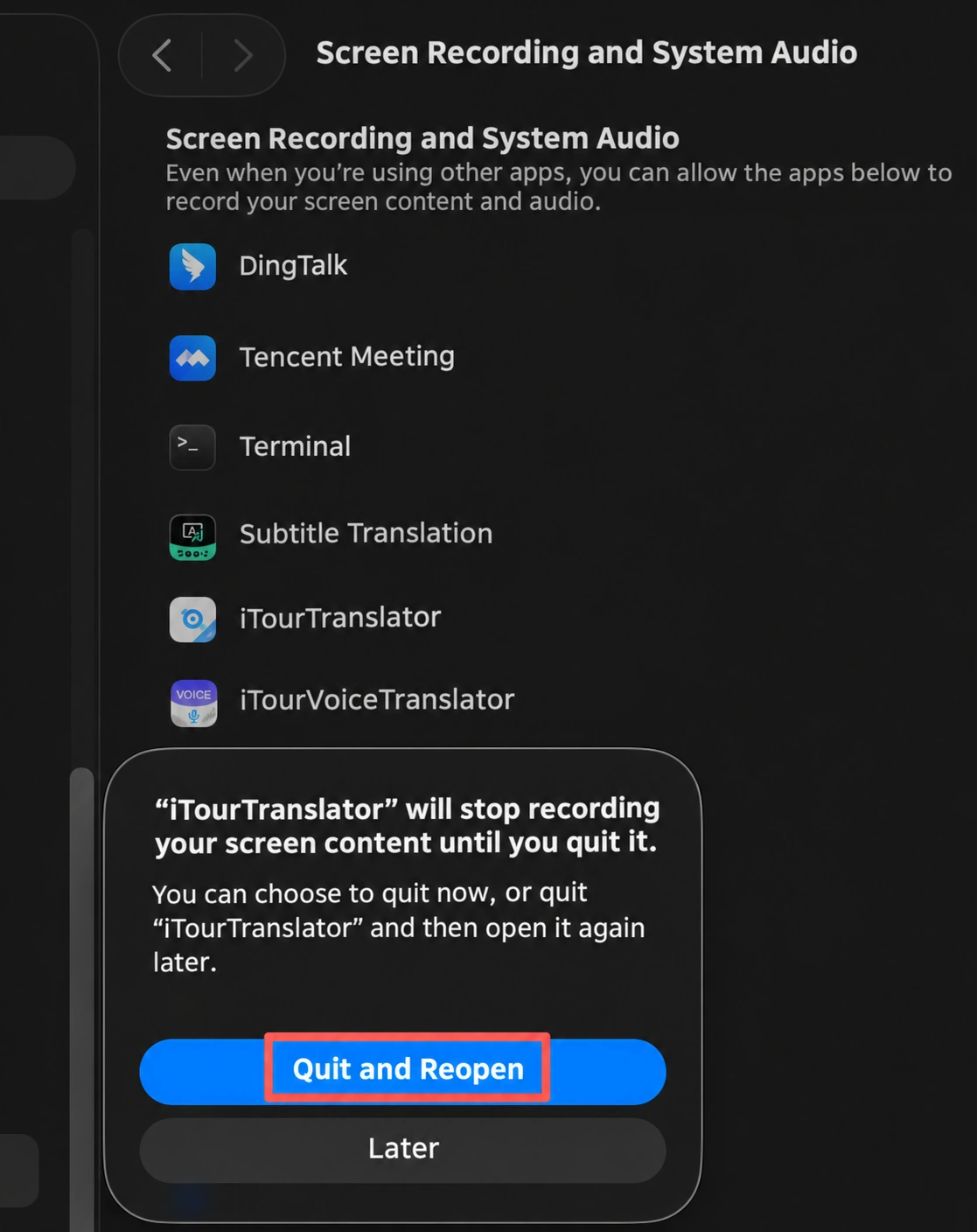
Please follow the steps below:
- Completely exit iTour Translator
Please make sure to right-click the icon in the Dock and select 'Quit', or use the Command (⌘) + Q shortcut to completely close the application.
- Restart the application
Open iTour Translator again and try to turn the translation function back on.
If the problem still exists after restarting, it is recommended that you:
- Check whether the permissions are granted correctly: Go to System Settings > Privacy & Security > Screen Recording, make sure the iTour Translator permission toggle in the list is turned on (the button on the right is blue ✅).
- Try re-authorizing: You can temporarily turn off this permission switch, then turn it back on, and then restart the application again.
Usually, the permissions take effect after completing the restart steps, and the translation function will return to normal. If the problem persists, please check whether the software is up to date, or contact Customer Support
iTour Voice Translator Mac computer: After PPT or meeting software is in full screen, the translation floating window disappears. What’s going on?
This is due to the design limitations of the macOS system. When an application (such as PPT or meeting software) enters full-screen mode, the system treats it as an exclusive 'desktop space,' and other applications (including translation floating windows) will not be able to appear above that full-screen window.
You can try the following methods to solve it:
Exit full screen mode
In PPT or meeting software, click the green 'Full Screen' button in the upper left corner of the window, or press the ESC key on the keyboard to exit full screen, change to Windowed mode You can use it, and the translation pop-up will display normally.
On a Windows computer, why is there no translation sound after connecting a Bluetooth headset or wired headset when using software like Zoom, Tencent Meeting, or Teams?
This problem is usually caused by the audio output path between the headset and the translation software not being correctly matched. Please check and set it according to the following steps:
Step 1: Confirm the connection sequence and software settings
- Please make sure that the headphones are successfully connected to the computer before turning on the translation function.
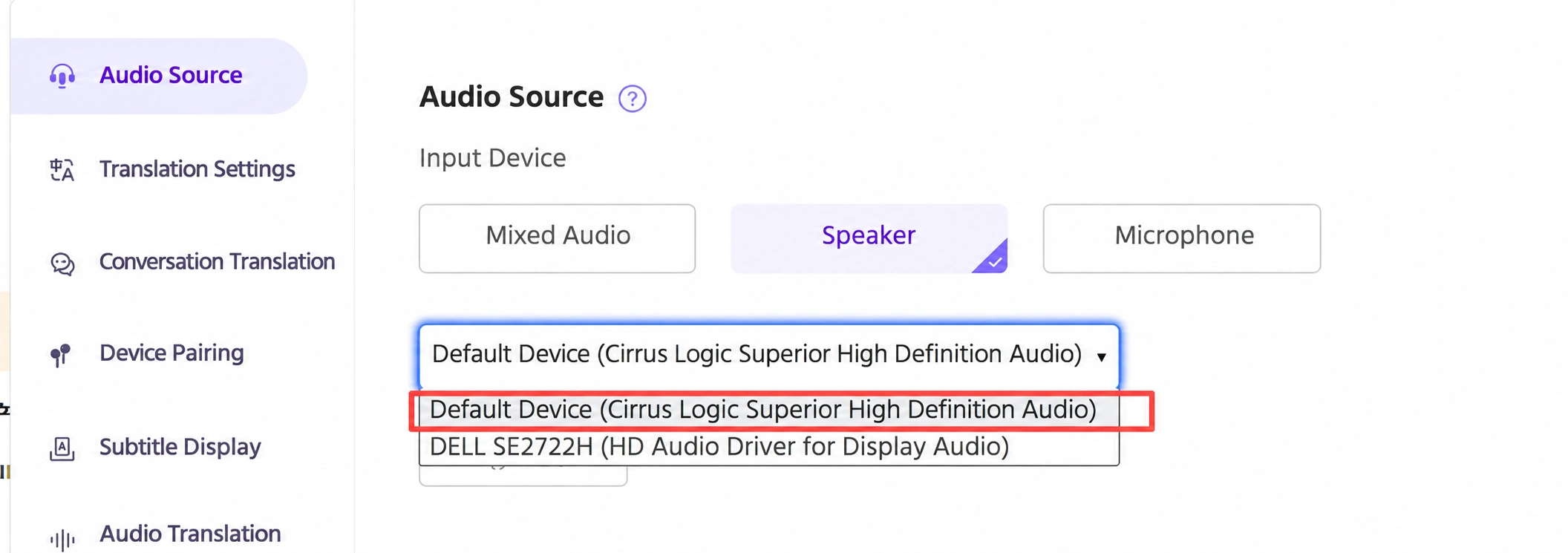
- If you connect or switch headphones during the translation process, please first turn off the translation, go to the software [Settings] → [Audio Source Settings] → [Speaker], confirm that the speaker option is set to your connected headphone device, and then turn the translation back on.
Step 2: Unify the audio output devices of the meeting software and translation software
- In the meeting software you are using (such as Zoom, Tencent Meeting, Teams, etc.), go to the audio settings and confirm the selection of 'Speaker' or 'Output Device'.
- Make sure that the device selected in the meeting software is exactly the same as the device chosen in iTourVoiceTranslator “Settings”→“Audio Source Settings”→“Speaker” (for example, both select 'XXX Bluetooth Headset' or the same wired headset device).
If the above steps are all set correctly and there is still no translation voice, this may be due to a system audio driver or device recognition anomaly. It is recommended that you restart the translation software and reconnect the headphones before trying again. If the problem persists, you can contact Customer Support for further troubleshooting.
Why does iTourVoiceTranslator not translate when using headphones on a Windows system, but works normally after unplugging the headphones?
This is usually because the software fails to correctly recognize your headset device at startup. Please try to resolve it in the following order:
Step 1: Ensure the correct startup sequence
- Correct order: First plug in the headphones → then turn on iTour translation.
- If the order is wrong: Please turn off translation → keep the headphones connected → turn translation back on.
Step 2: Manually lock the output device (if Step 1 is ineffective)
- Turn off translation.
- Please confirm whether the device selected in [Settings → Sound Source Settings → Speakers] is the headphone device you are currently wearing.
- If not Please manually change to your headphone device, then go to the function page and restart the translation.
- If it is: Please go directly to the function page to restart the translation.
iTour Voice Translator Windows Computer: How to Use the Speaking Translation Function?
The speech translation feature allows you to translate your own speech during a meeting and play it back to the other party. Currently, this feature requires High-precision Interpretation or DeepL Interpretation. Follow the steps below on Windows:
1. Function Description
- Only recognize and translate your own speech, and the translation result can be broadcast to the meeting counterpart through a virtual driver.
- You need to purchase in advance and install a virtual microphone driver to use it.
2. Operating Steps
① Turn on speech translation:Function floating window → Top right corner settings → Speech translation
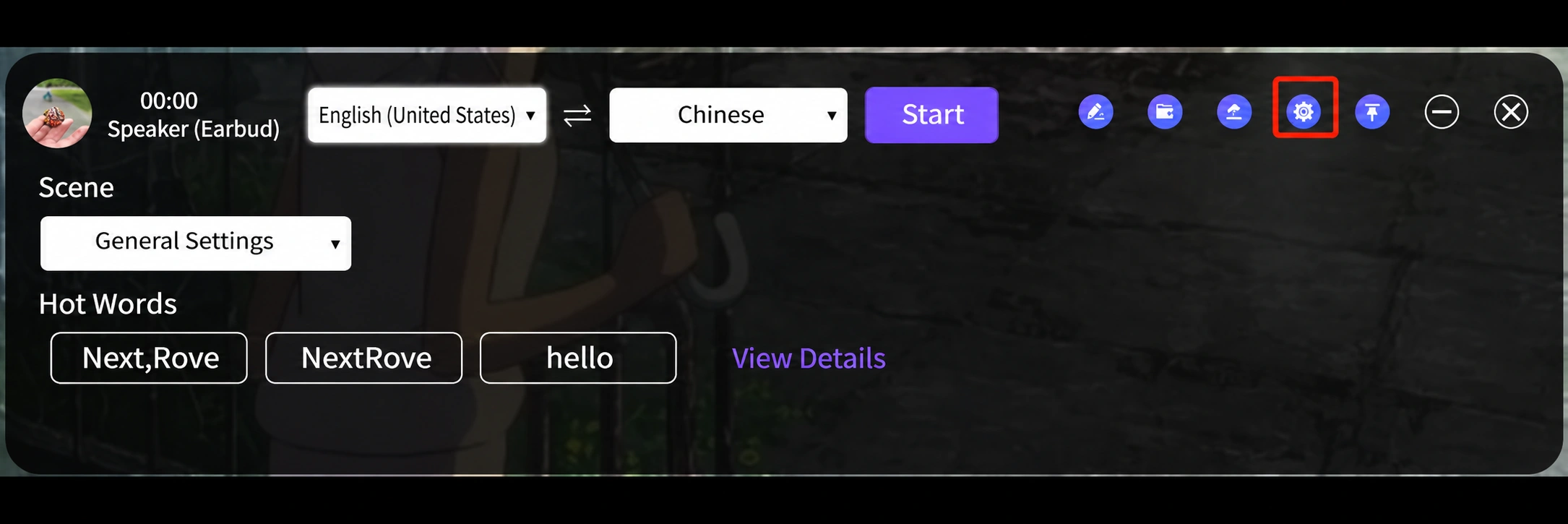
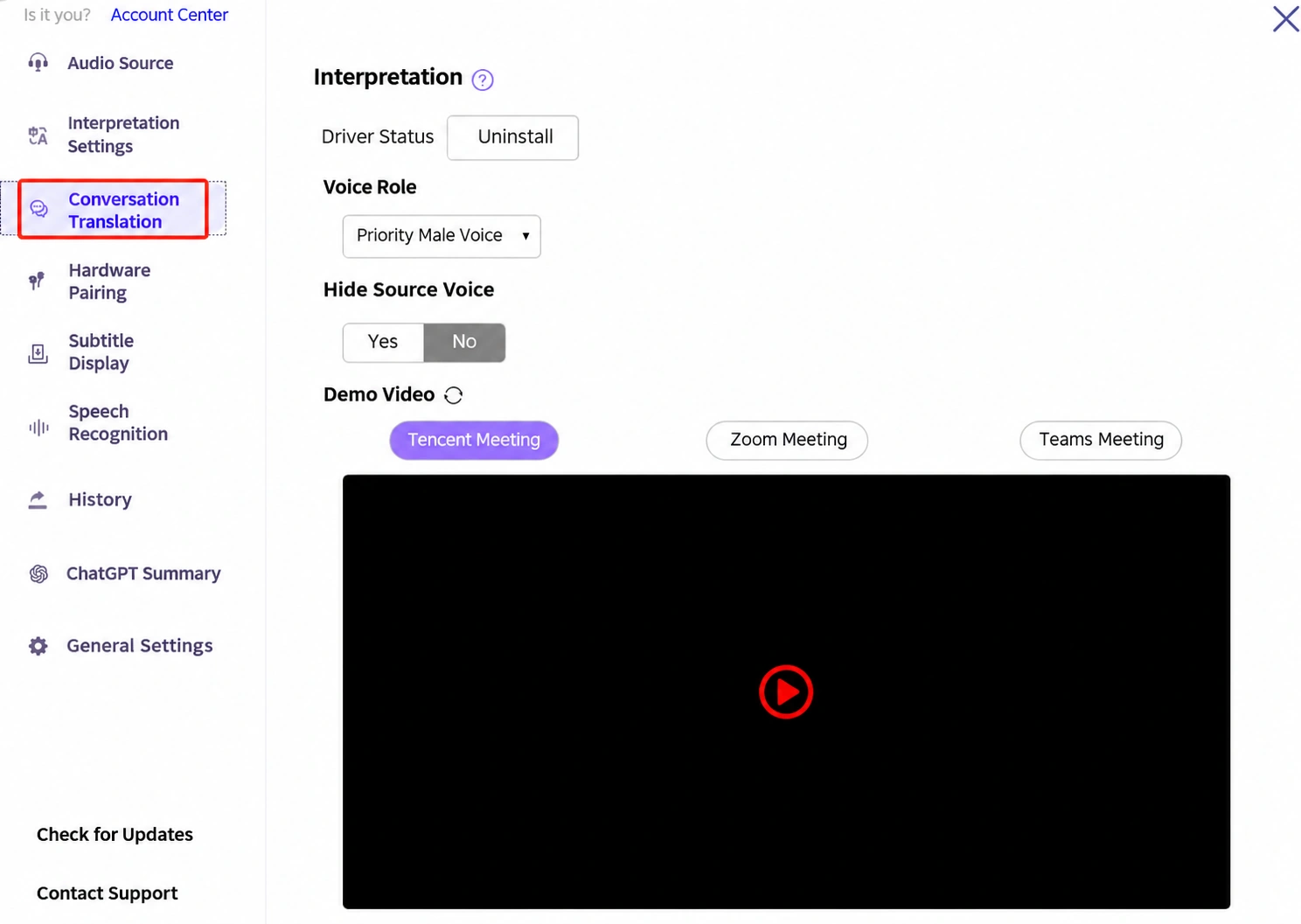
② Purchase and install the driver: If you have not purchased the virtual audio driver, follow the on-screen instructions to purchase it, then click “Install” in Speech Translation settings.
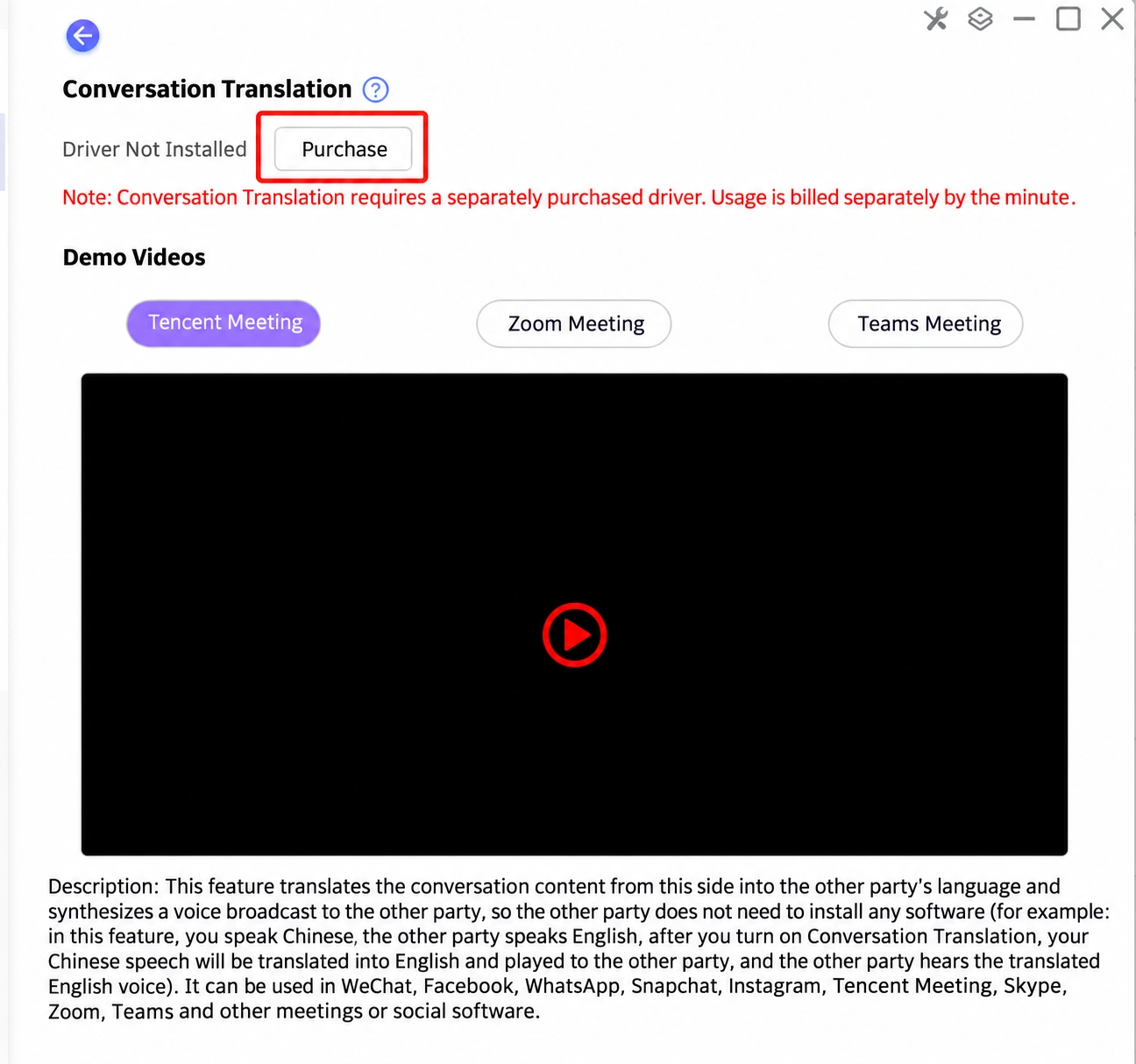
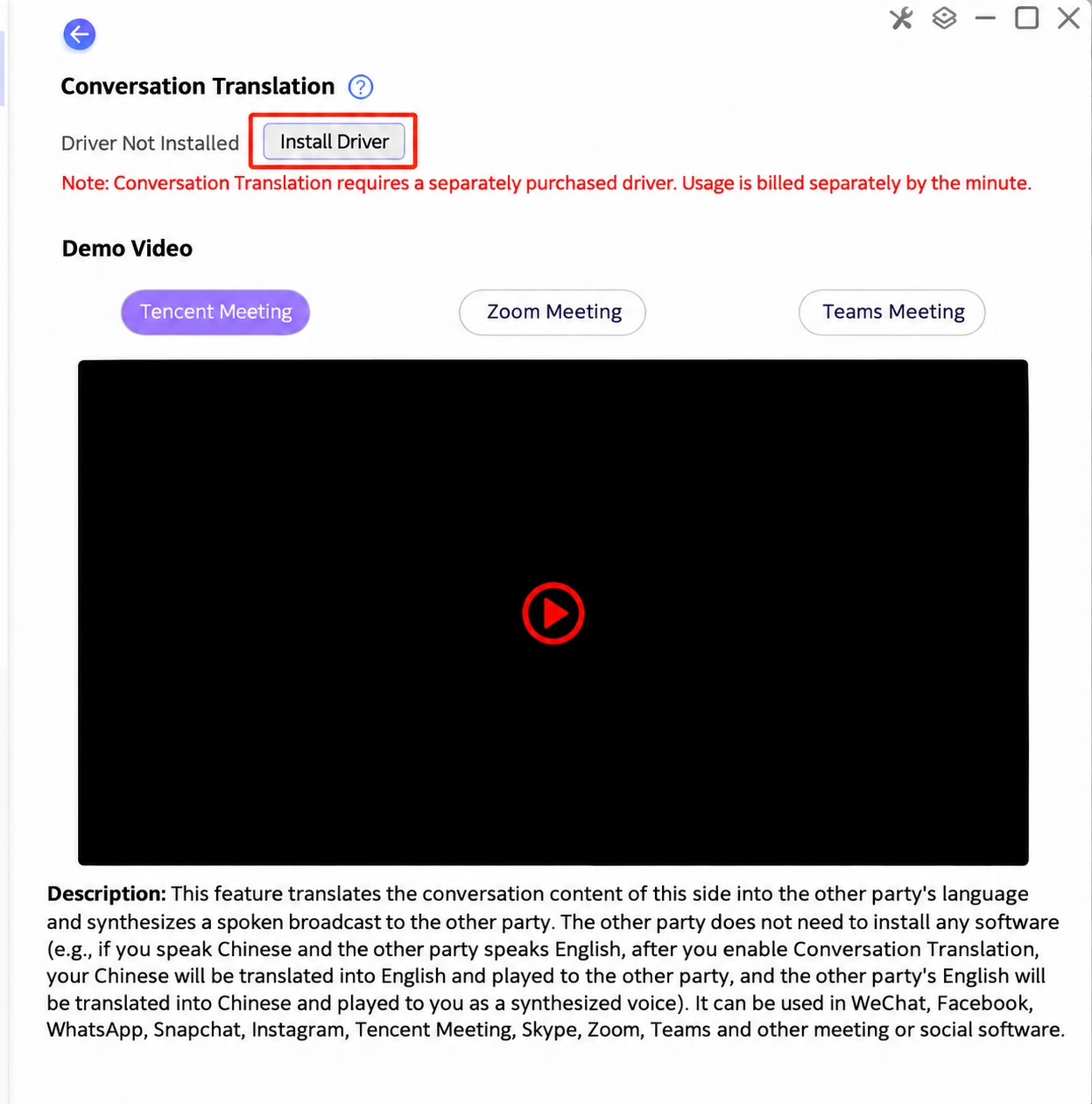
③Effective after restarting the software: After the installation is successful, please restart the software. The translation page will display the 'Speech Translation' button.
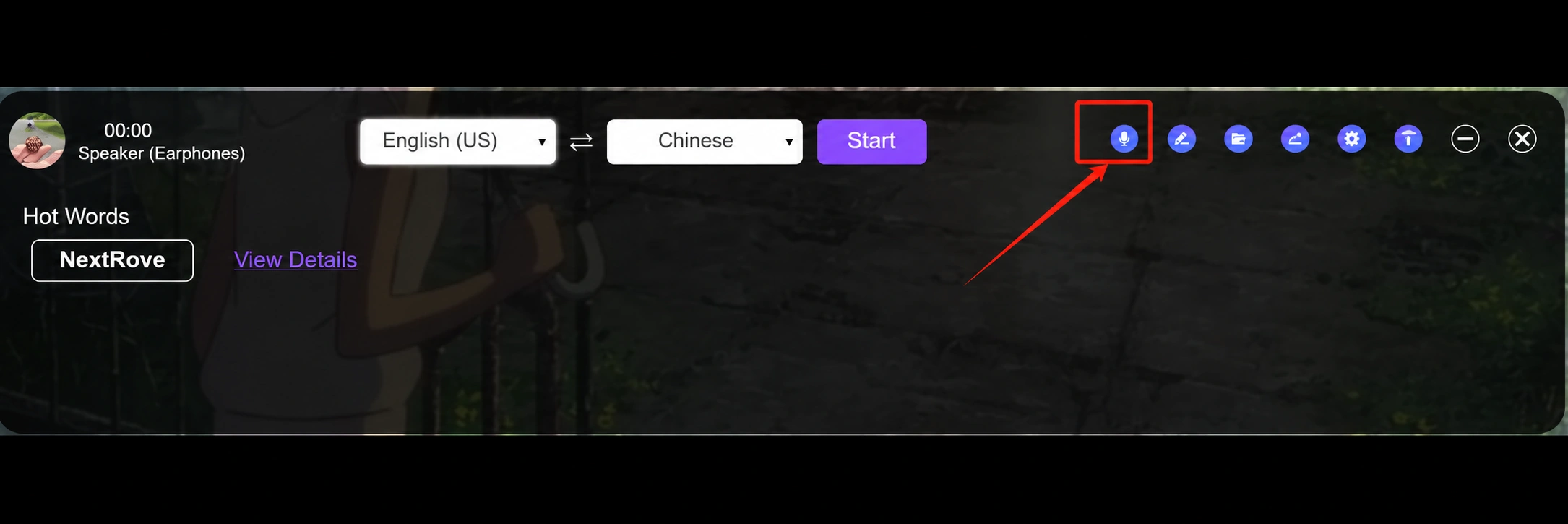
④ Meeting software settings: In software like Zoom, Tencent Meeting, Teams, set the microphone to: Hi-Fi Cable Output (VB-Audio Hi-Fi Cable)
Note: Order of use:
- Open the speech translation floating window
- Start translation
- Click the [Mute/Microphone] icon button in the meeting software
- Make sure the meeting microphone is set to the virtual audio driver: Hi-Fi Cable Output (VB-Audio Hi-Fi Cable).
- Speak into the computer microphone
- The recognition result will be automatically translated and announced to the other party.
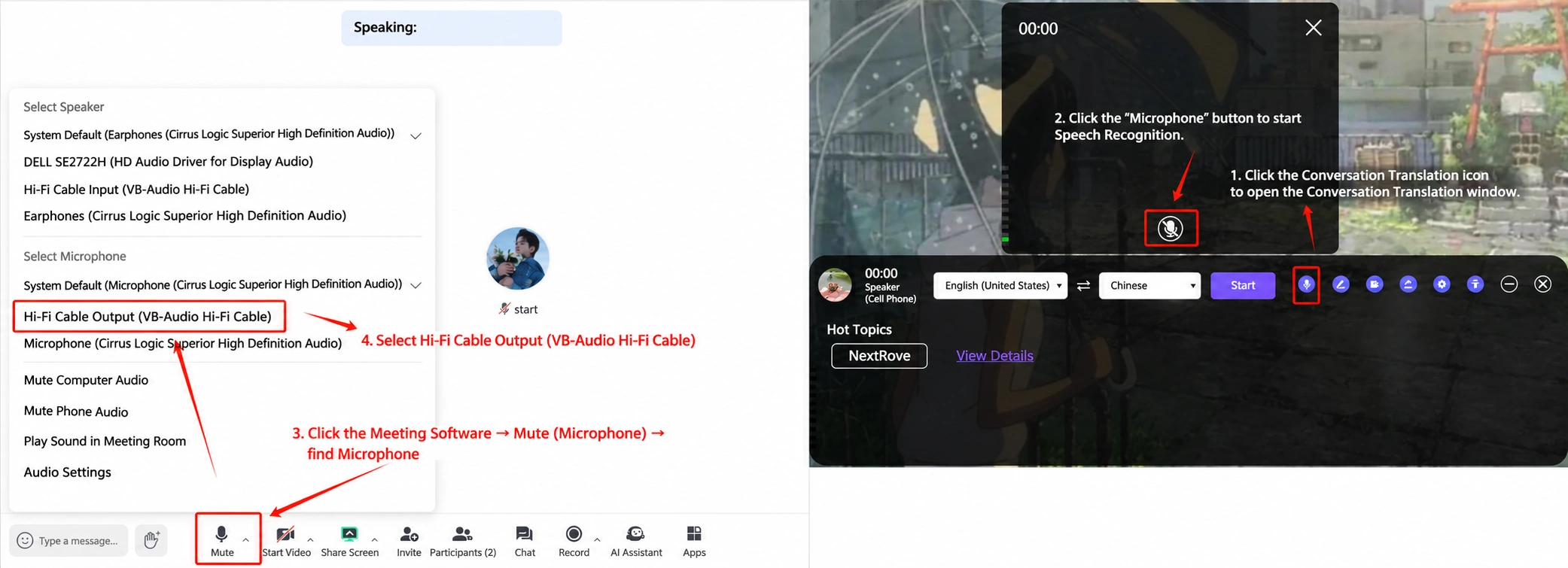
3. Precautions
- Please follow the above order strictly, otherwise it may not broadcast properly.
- If you encounter recognition or broadcasting issues, please check whether the virtual driver is installed successfully, or reselect the meeting microphone device.
- It is recommended to test in advance
If you have any other questions, you can contact Customer Support.
iTour Voice Translator MAC Computer: How to Use the Speaking Translation Function?
The speech translation feature is currently only supported High-precision Interpretation and Deepl simultaneous interpretation Two modes, mainly used to recognize and translate your own speech content.
Please note before use:
This feature is only available in Audio Input Mode is set to Speaker . It is unavailable with other audio sources.
Operating steps:
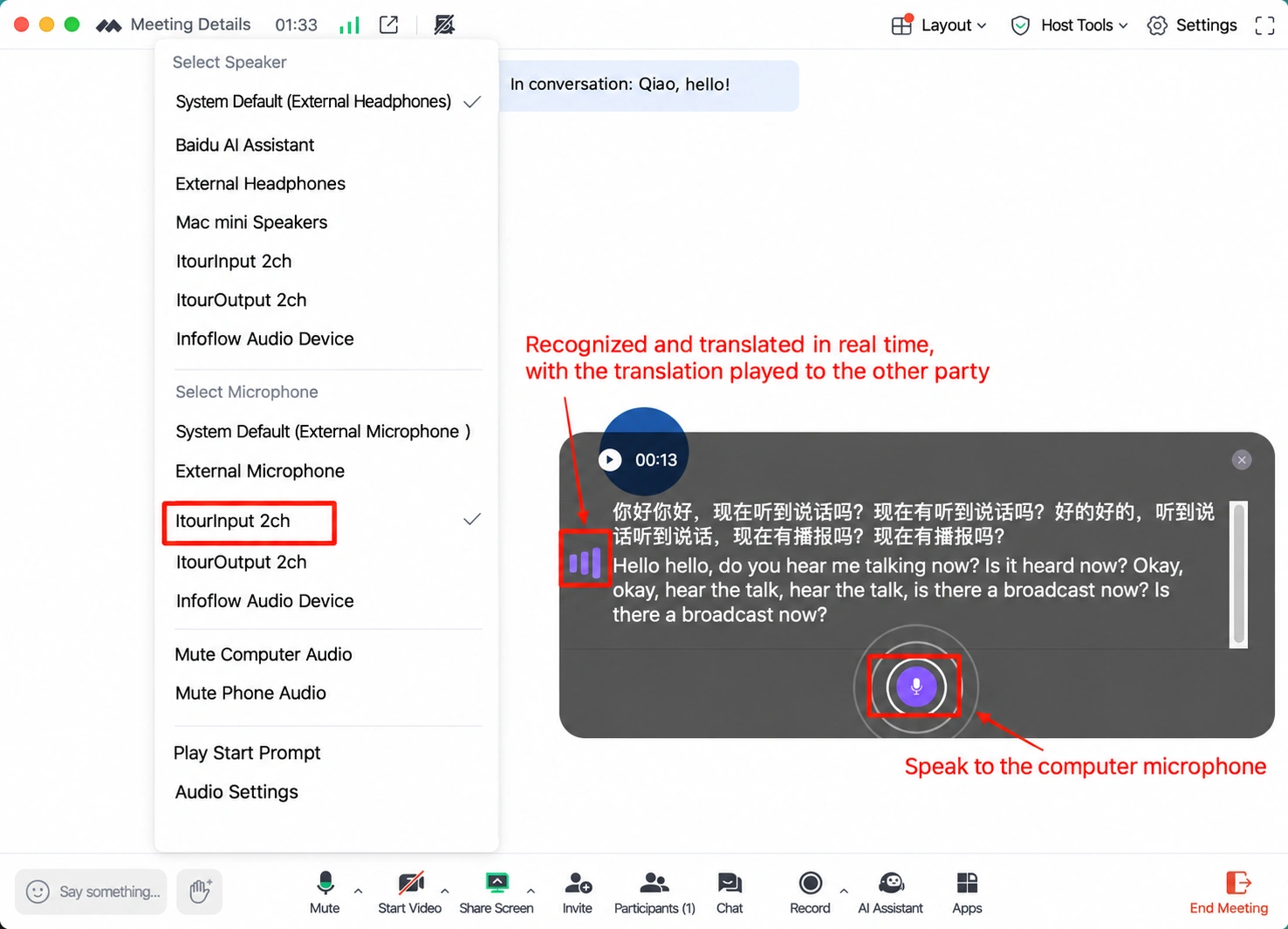
- Turn on the speech translation switch:Function Floating Box — Top Right [Settings] — Speech Translation
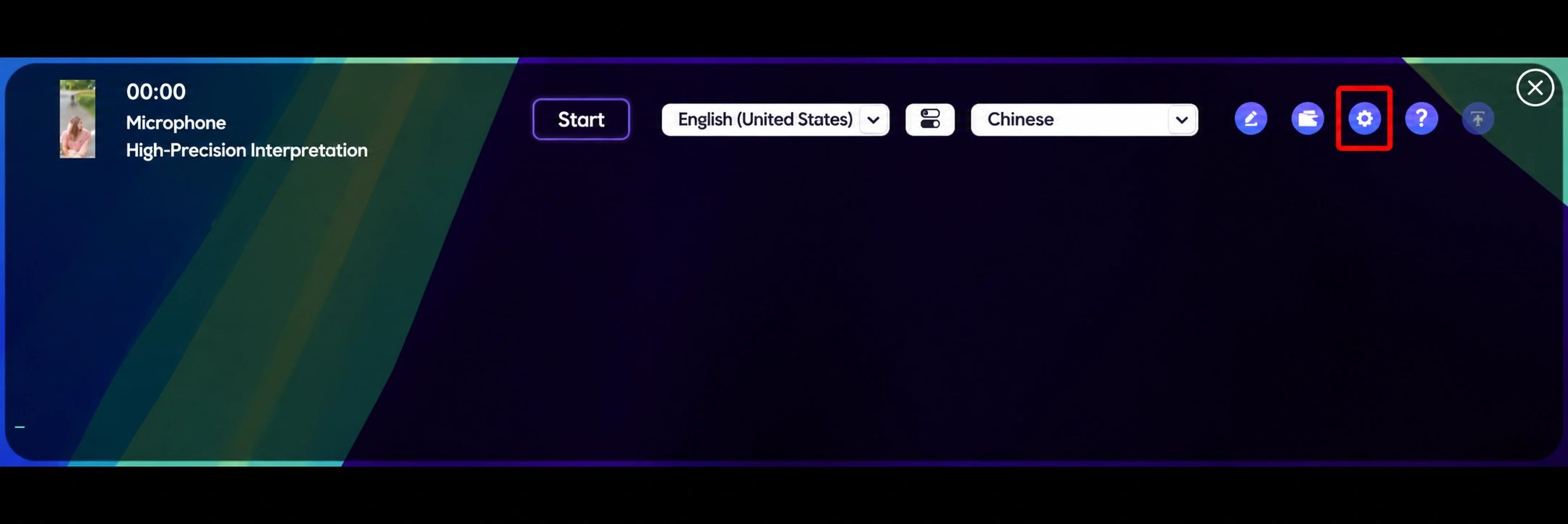
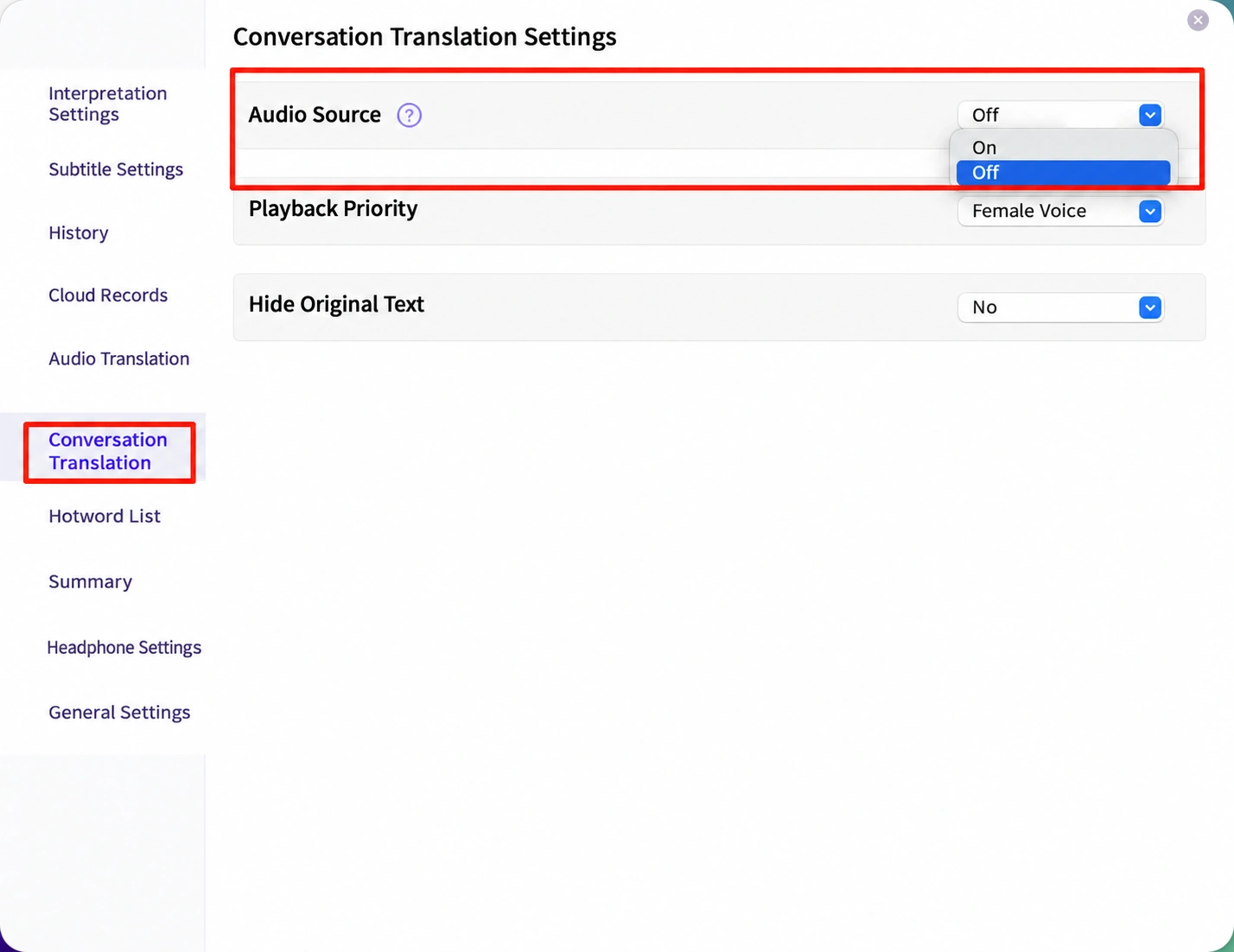
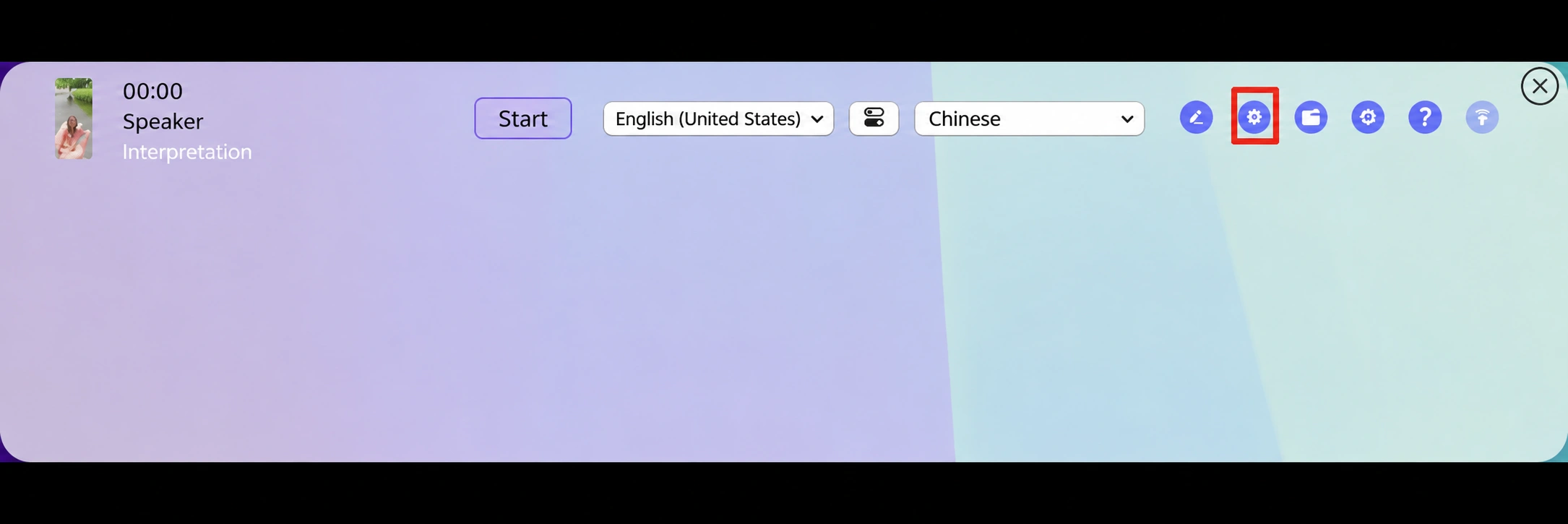
2. Return to the simultaneous interpretation interface
After setting it, the top right corner of the page will display "Speech translation” button.
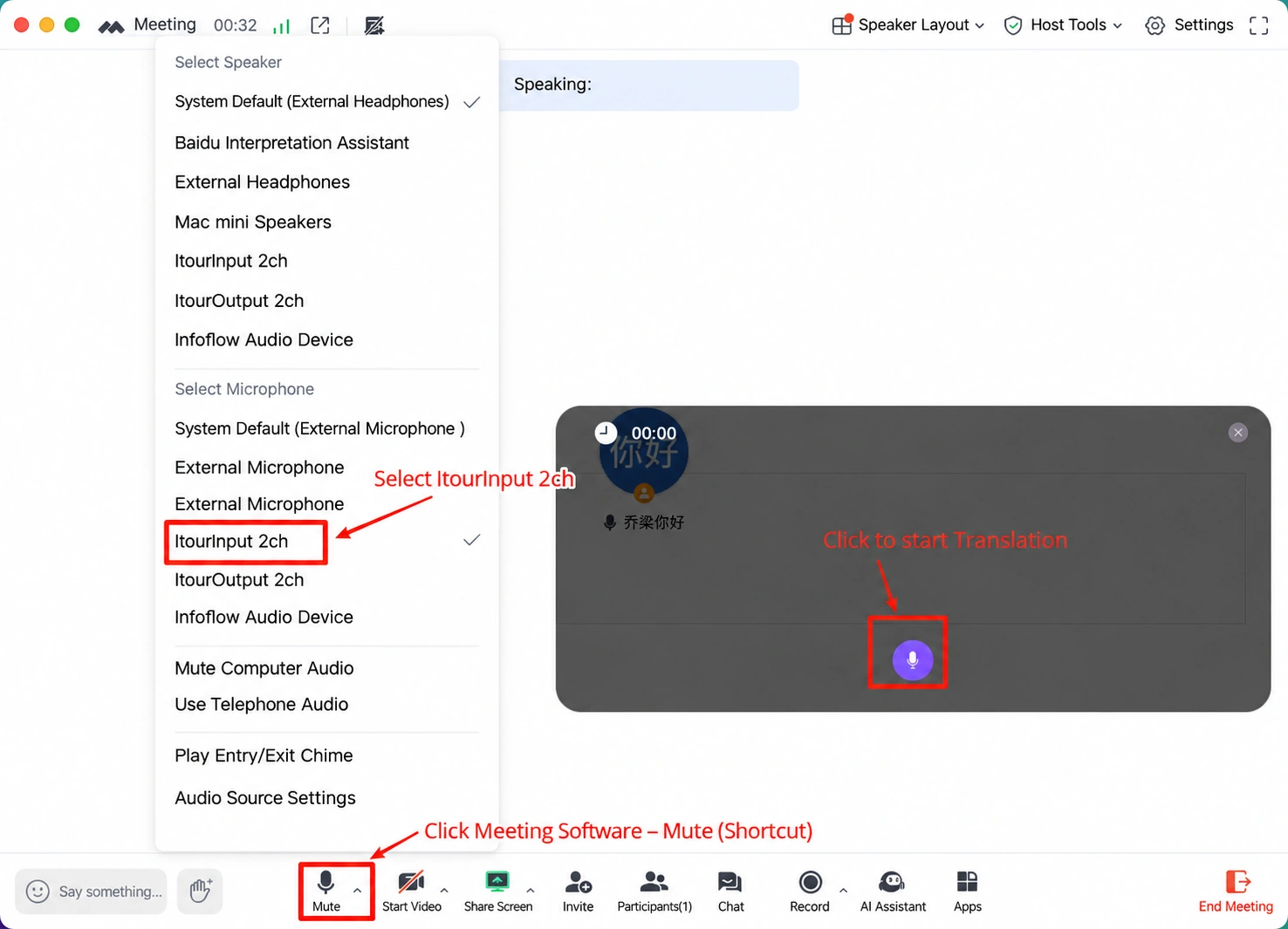
3. Start translating and using
- Click "Speech translation” to enable the feature, then start translation.
- In meeting software such as Zoom, Tencent Meeting, and Teams, set the microphone to 'itourInput 2ch'.
4. Speak into the microphone
Speak directly into the computer microphone, and the system will recognize your voice and translate it. The translation will be played to the other party through the speakers.
After using the 'Speak Translation' feature of iTour Voice Translator, why wasn't what the other person said translated?
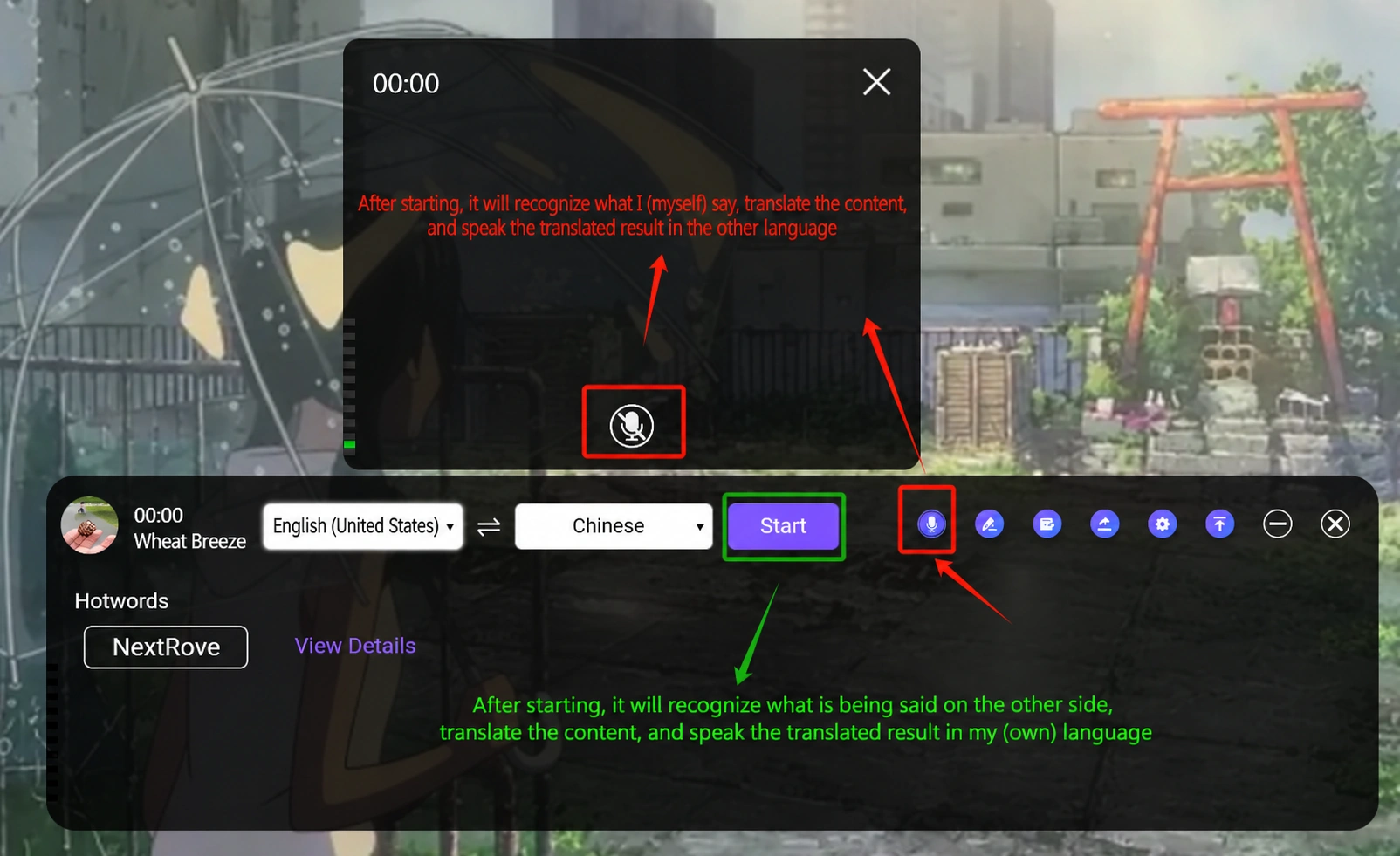
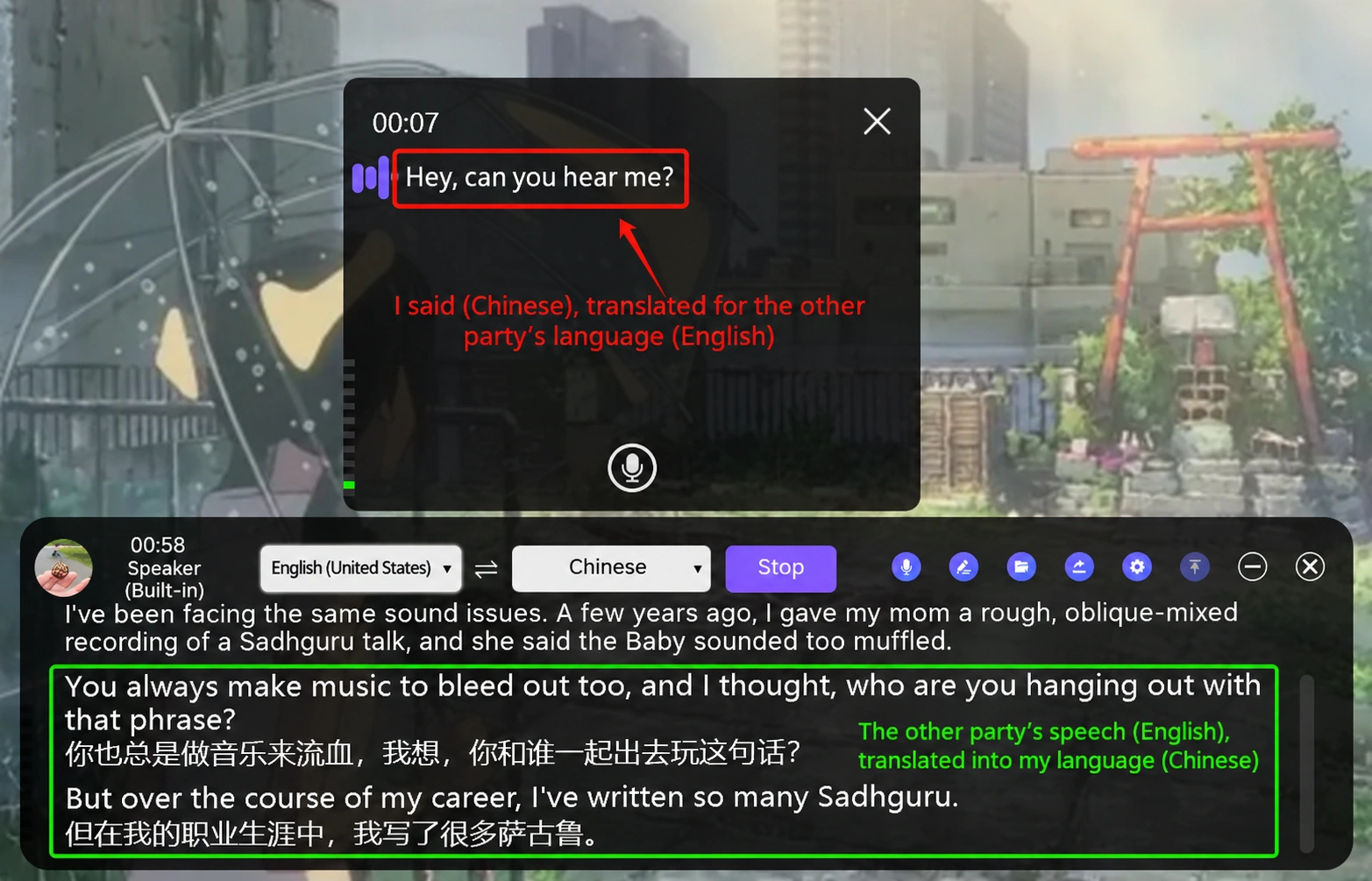
This is because The 'speech translation' feature is mainly used for one-way translation. Its design is: to recognize and translate what you say, and then broadcast the translation to the other person.
If you need to understand what the other person is saying, you need to make the settings as shown in the following diagram:
When using the 'Speak Translation' feature of iTour Voice Translator, is it possible to prevent the other person from hearing my original voice?
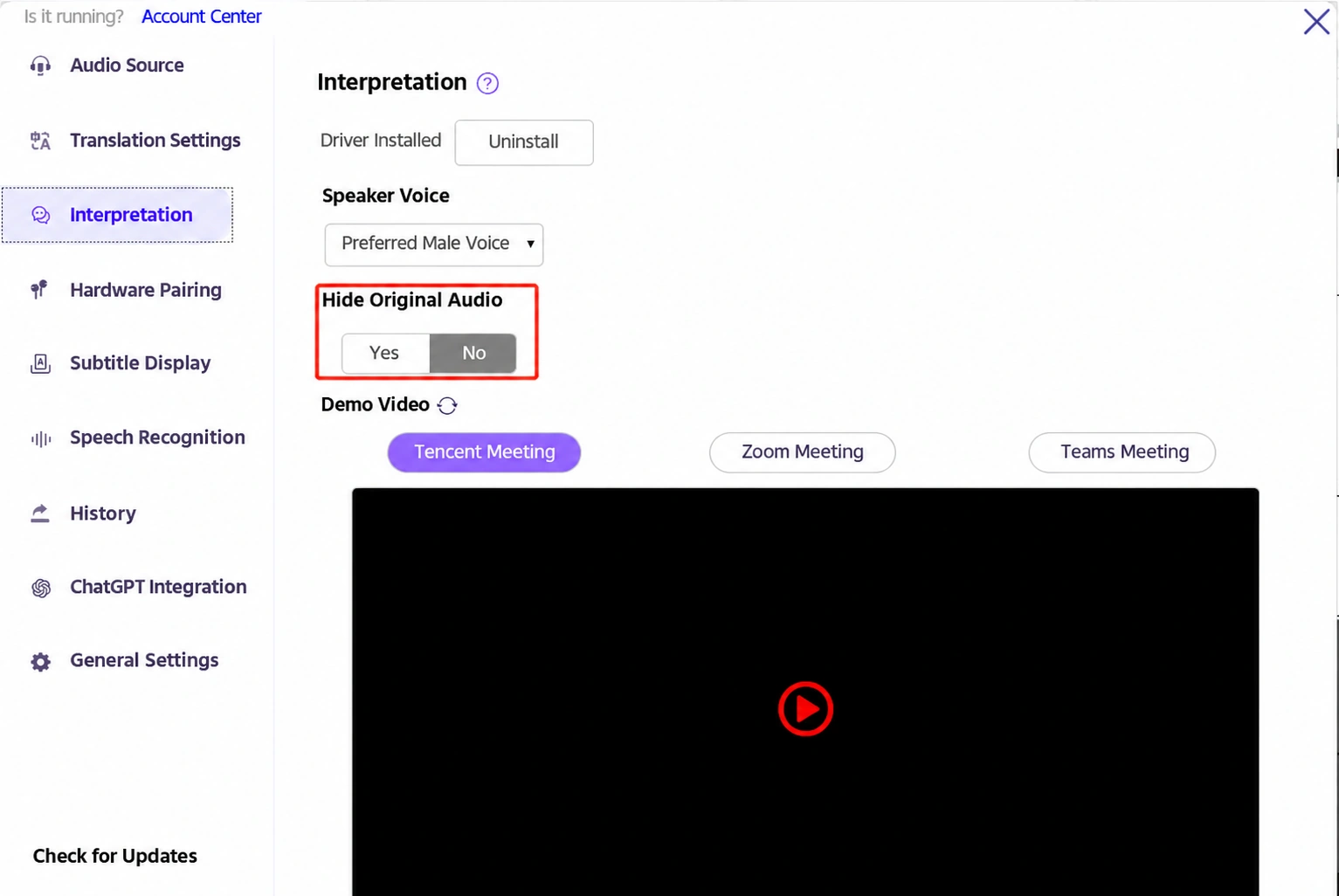
Yes, you can achieve this by enabling the 'Hide Original Sound' feature.
Settings Path:
Click the “Settings” icon in the upper right corner of the main software interface to enter the “Speech Translation” settings page, find the 'Hide Original Voice' option, and switch it to yes That's all.
What to Expect:
After enabling this feature, the other party will only be able to hear the content of what you say Translated Speech, and will not hear your original voice.
After installing the speaking translation driver for iTour Voice Translator on a Windows computer, the other party in the meeting cannot hear my voice. How should I resolve this?
This issue is usually caused by a conflict in the audio routing settings. Please follow the steps below to check and adjust them in order, and you will be able to restore your microphone sound:
Option 1: Check the microphone settings within the software
- Open iTour Voice Translator.
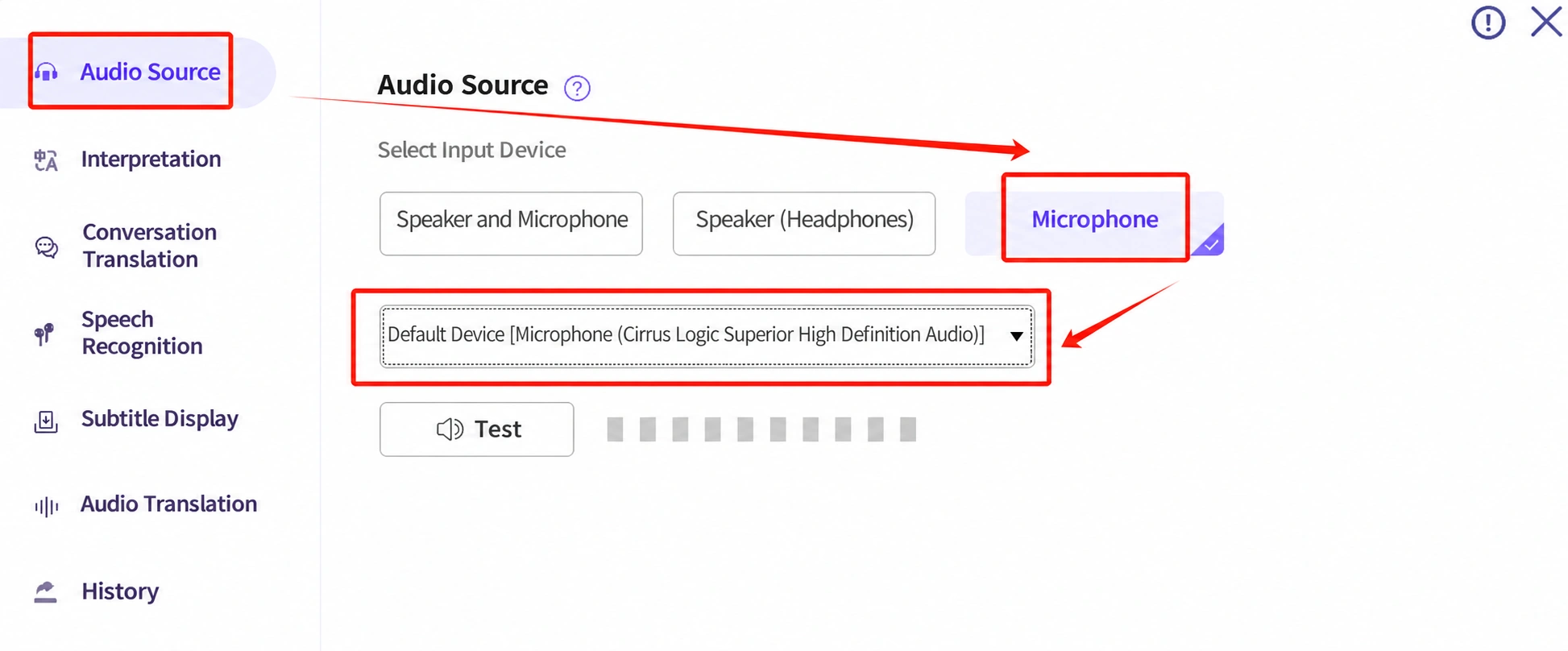
- Go to Settings → Audio Source Settings.
- Check whether the 'Microphone' option has been mistakenly selected as 'Hi-Fi Cable Output (VB-Audio Hi-Fi Cable)'.
- If so, please change it to the actual microphone device on your computer (such as 'Built-in Microphone' or the name of your external microphone).
Option 2: Check Windows system recording devices
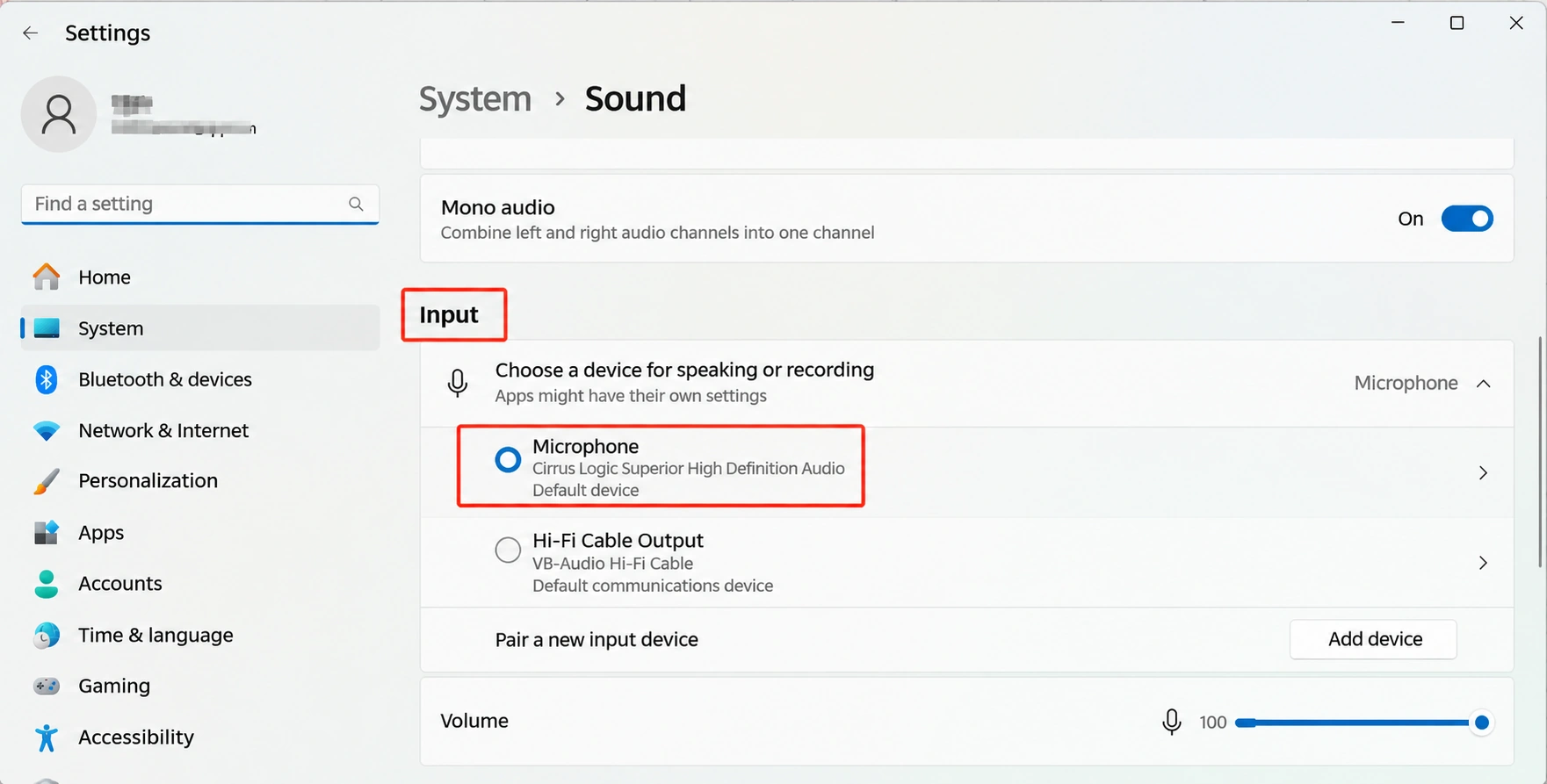
- Right-click the speaker icon at the bottom right corner of the computer screen, and select [Sound settings].
- In the 'Input' device list, confirm whether 'Hi-Fi Cable Output (VB-Audio Hi-Fi Cable)' is selected.
- If so, please switch it to the correct microphone device.
Important Notes:
- Only when using the speech translation function, you only need to select " in the microphone settings of the meeting software (such as Zoom, Tencent Meeting, etc.)Hi-Fi Cable Output", so that the software can take over and translate your voice.
- When not using the speech translation function, please be sure to switch the microphone in the meeting software back to your normal microphone device, otherwise the other party will not be able to hear your voice.
Why does iTour Voice Translator not display the translation content after enabling translation on Mac computers with macOS versions below 13?
This issue is usually caused by the audio output not being correctly directed to the translation channel. Please check and set it in the following order:
Step 1: Make sure the translation is turned on correctly
- In iTour Voice Translator, click [Start] to begin translation.
Step 2: Set up the speaker in the conferencing software
- Open the meeting software you are using (such as Zoom, Tencent Meeting, etc.).
- Enter the audio settings (or 'sound settings') interface of the software.
- In the Speaker/Output Device options, select the 'iTourMulti-Output' device.
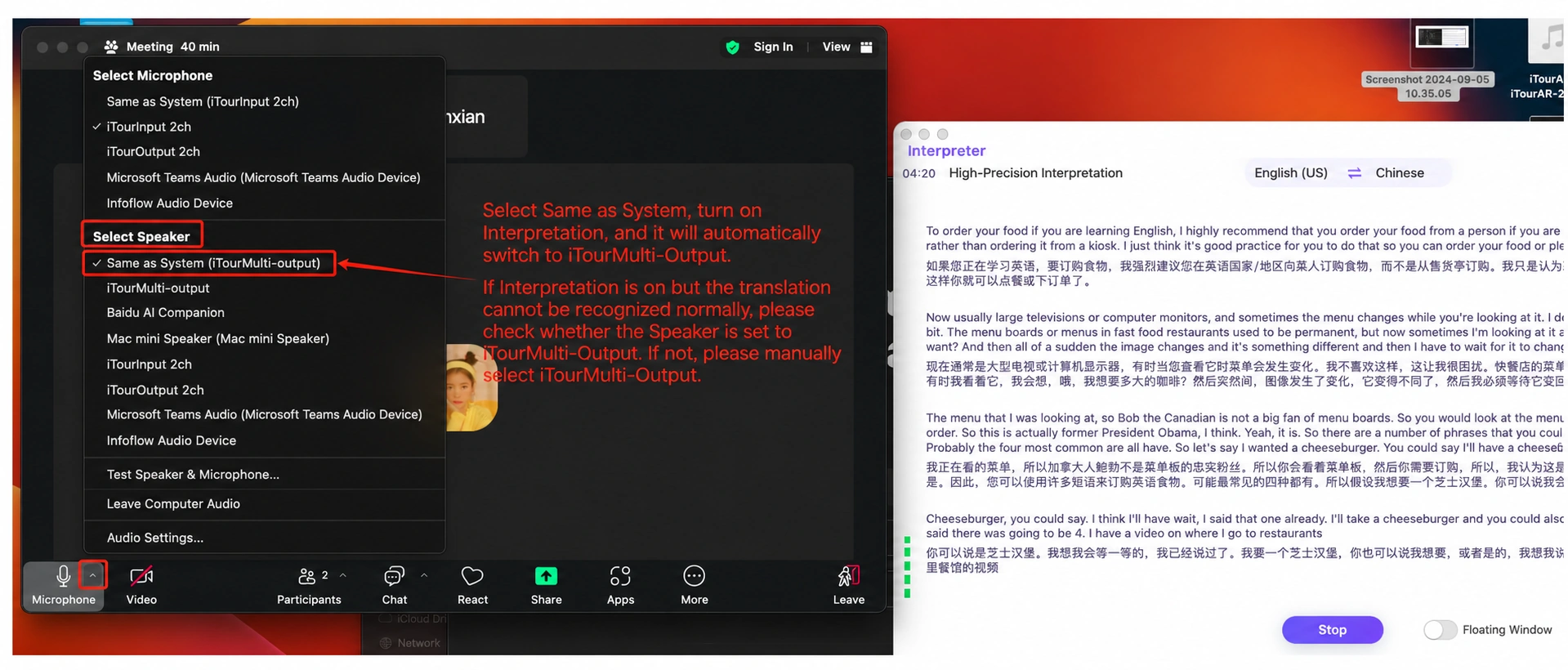
Please pay attention to the operation sequence:
Be sure to first Turn on simultaneous translation in iTour Voice Translator,again Select the corresponding speaker device in the meeting software. Reversing the order will cause the system to fail to correctly route the translation audio.
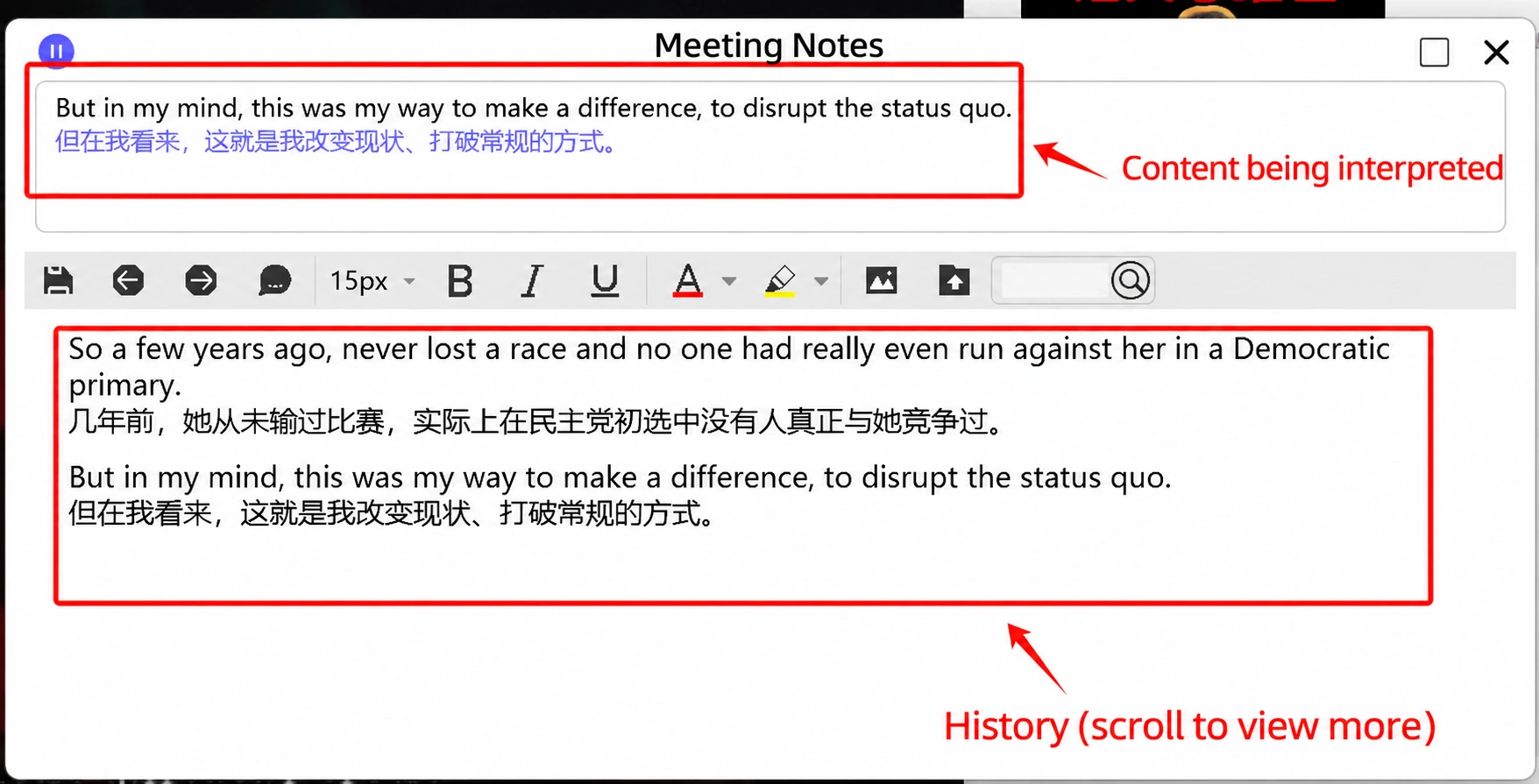
When using iTour Voice Translator for simultaneous interpretation, how can you pause the real-time refresh to view previous translation content?
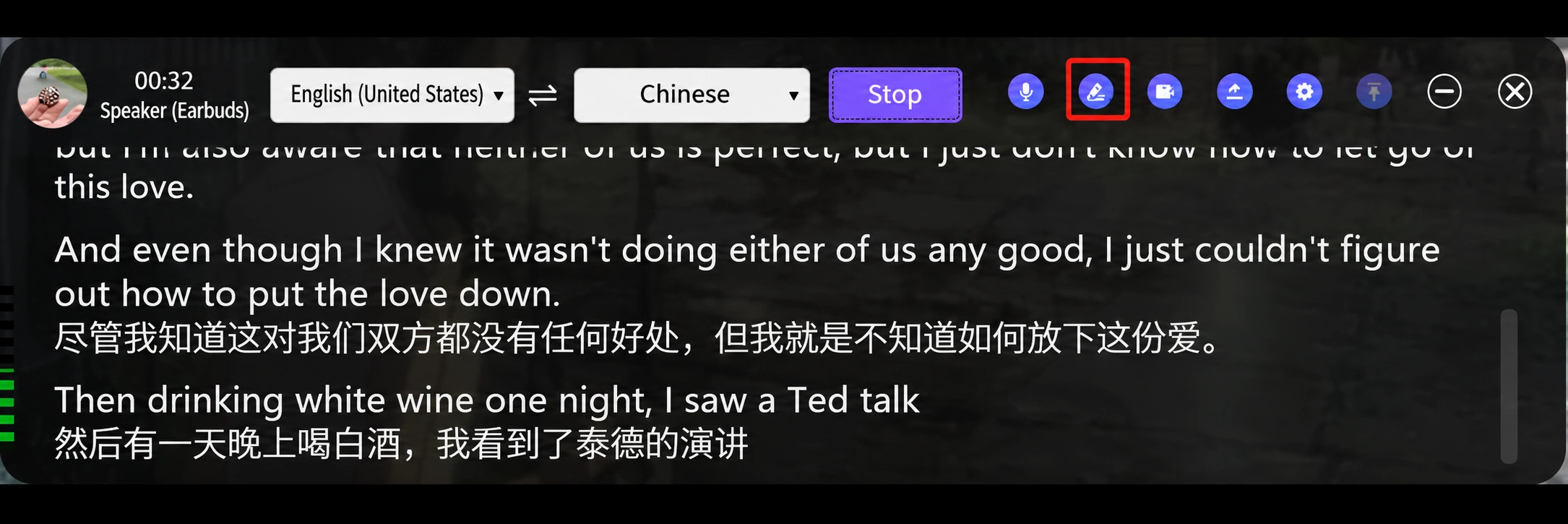
You can view the complete translation history through the 'Meeting Minutes' feature. This feature saves all translation records, allowing you to browse them at any time without being affected by real-time updates.
The specific operation interface is shown in the figure below:

I have purchased and installed the speaking translation driver for iTour Voice Translator. Why doesn't the 'Speaking Translation' icon appear on the floating window?
This situation usually occurs because the corresponding simultaneous translation type has not been activated in the software. Please follow the steps below:
Operating steps:
- Click the “ at the top right corner of the main interface Settings” Icon (⚙️).
- Enter [Translation Settings”.
- In the translation engine, select to enable "High-precision Interpretation" or "Deepl simultaneous interpretation Any one of the items in
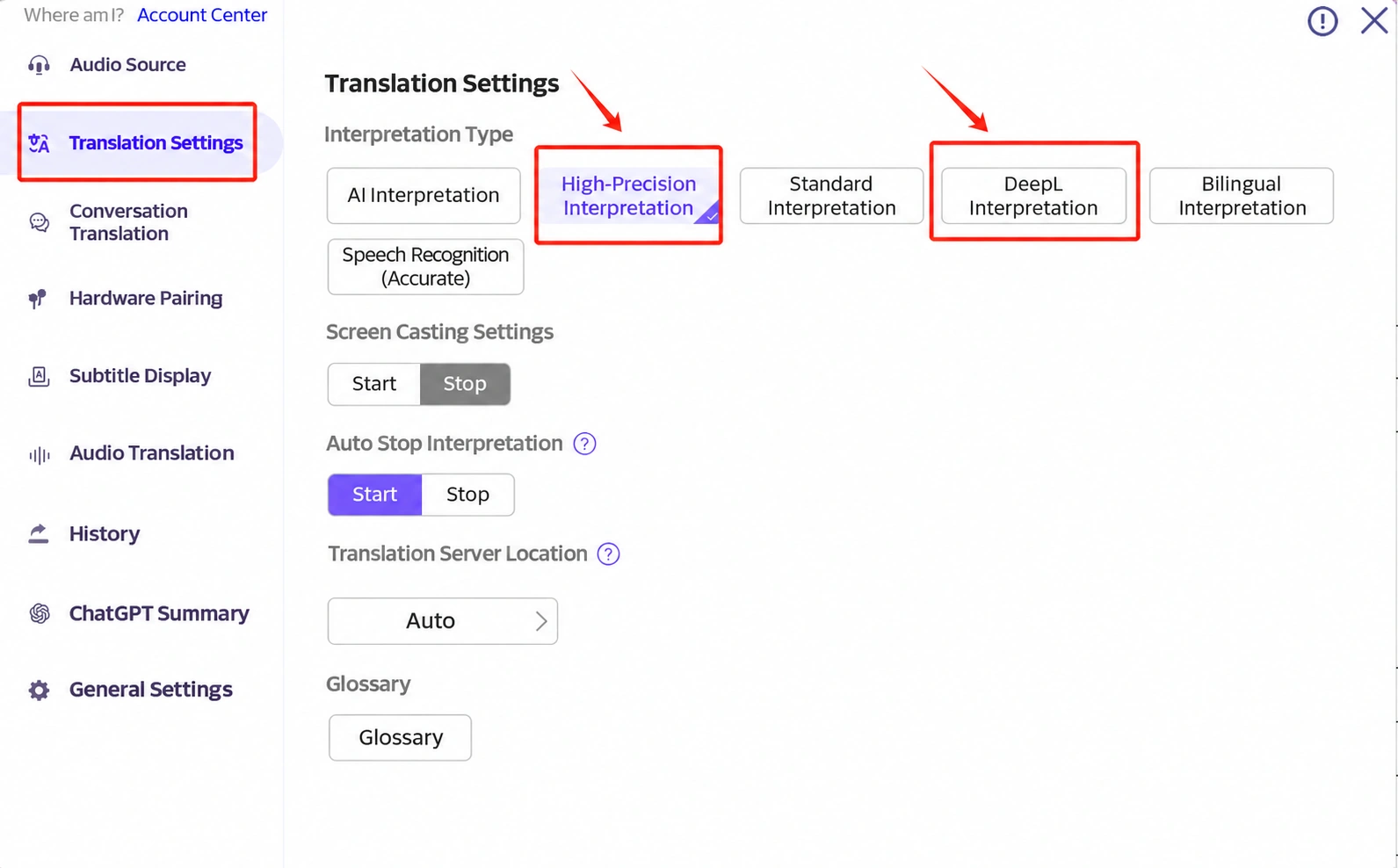
Explanation:
"Speech Translation" is an enhanced feature that operates based on the above-mentioned simultaneous interpretation translation types. Only after activating any of the above translation types will the system load and display the microphone icon for "Speech Translation" in the floating window, after which you can use this feature normally for voice input and real-time translation playback.
Didn't find the answer?Contact Online Customer Service ↗ · Contact us · Return to Help Center

 Support